Help Spread Eternal Sanatana Knowledge
Support our sacred mission of preserving, imparting, and expanding authentic Hindu wisdom across the globe by promoting this specific article.
Understanding the Divine:
Deities, Avatars, and Cosmic Time
Exploring the rich traditions of Gods in hinduism reveals the eternal philosophy of one ultimate reality manifested in infinite divine forms, cosmic preservers, feminine powers, and vast cyclical cosmic ages.
One Divine Reality in Many Forms
At the heart of Hindu philosophy lies a profound truth: ultimate reality is one, yet expressed through infinite manifestations. The ancient scriptures, particularly the Vedas, describe this Supreme Cosmic Reality as Brahman—an formless, infinite, and changeless truth that underlies all existence.
Rather than viewing different deities as competing gods, Hindu thought understands them as distinct facets of the same single reality. Just as light passing through a prism splits into a spectrum of vivid colors, the unmanifest Brahman manifests as various divine forms to connect with human consciousness, devotion, and understanding.
The Prism Analogy of Brahman
Think of Brahman as pure, white sunlight. When passed through the glass prism of creation, it projects divine rays—as Vishnu, Shiva, Durga, or Ganesha. Though differing in color and form, the source remains whole and indivisible.
The Trinity (Trimurti): Brahma, Vishnu, Shiva
To explain how the universe functions, Hindu tradition presents the Trimurti—the cosmic triad representing the three essential forces of existence: creation, preservation, and transformation.
Brahma
Brahma represents the creative energy that brings the universe and all living beings into existence. He is typically depicted with four heads, symbolizing the four Vedas and the four directions of space.
Vishnu
Vishnu is the cosmic force that maintains order, harmony, and righteousness (Dharma) in the universe. Depicted with dark blue skin and holding symbolic items like the conch and lotus, Vishnu actively sustains life.
Shiva
Often referred to as the Destroyer, Shiva represents the necessity of change, transformation, and liberation. His destruction is not malicious; rather, it dissolves the old to clear space for new creation.
The Divine Feminine (Shakti / Devi)
In Hinduism, the ultimate power that animates the universe is intrinsically dynamic and feminine, known as Shakti. Without Shakti, the cosmic order cannot function. The Divine Feminine manifests in three major forms:
Durga / Kali
Power & ProtectionDurga represents the fierce, protective aspect of the divine mother who destroys ignorance, cosmic imbalance, and demonic forces. She embodies supreme courage and righteous power.
Lakshmi
Abundance & HarmonyAs the consort of Vishnu, Lakshmi is the energy of wealth, prosperity, beauty, and spiritual abundance. She sustains the world by providing both material and spiritual well-being.
Saraswati
Knowledge & ArtsSaraswati represents wisdom, learning, music, and the creative arts. She guides seeker consciousness toward higher intellectual and spiritual realization.
Avatars: Why God Takes Form on Earth
The concept of an Avatar refers to the descent of the Divine into earthly form—either human or animal—to restore order whenever moral balance collapses. As Lord Krishna states in the Bhagavad Gita, God manifests on Earth whenever unrighteousness prevails, protecting the good and re-establishing Dharma.
ॐ"Whenever there is a decline in righteousness, O Bharata, and a rise of unrighteousness, then I manifest Myself. For the protection of the good, for the destruction of evil-doers, and for the re-establishment of Dharma, I am born in every age."
• Lord Rama
The avatar of righteousness, duty, and flawless virtue, whose life serves as an exemplar of moral conduct (*Maryada*) and unyielding devotion to truth.
• Lord Krishna
The avatar of divine love, spiritual wisdom, and supreme playfulness (*Lila*), whose teachings in the Bhagavad Gita guide human action and devotion.
Understanding Symbolism & Images (Murti Puja)
To the uninitiated, the reverence of sacred statues might look like idol worship. However, in Hindu tradition, this practice is known as Murti Puja—the sacred art of honoring divine presence through symbolic forms.
A Murti is not considered God in itself; rather, it acts as a vessel or physical anchor for divine energy. Just as a physical photo helps us connect with an absent loved one, a sacred image helps the mind focus during prayer and meditation.
Deconstructing Sacred Symbolism
Multiple Arms
Represents divine omnipotence, omnipresence, and the ability to carry out multiple cosmic duties simultaneously.
Sacred Items
Held items (lotus, weapons, books) symbolize purity, protection from ego, and the light of divine knowledge.
Mudras (Gestures)
Hand gestures convey active spiritual messages, such as fearlessness (*Abhaya*), blessing, or meditation (*Dhyana*).
The Concept of Time & Cosmology
Unlike linear views of time that have a single beginning and end, Hindu cosmology views time as vast, cyclic, and endless. Time moves in continuous cosmic cycles of birth, growth, decay, and renewal.
The Four Yugas (Ages of Humanity)
A single grand cycle (Mahayuga) lasts millions of human years and is divided into four distinct ages (Yugas), during which human morality and spiritual clarity gradually decline:
1. Satya Yuga (The Golden Age)
100% VirtueAn era of absolute truth, purity, and spiritual perfection. Humans live in complete harmony with divine law without deceit or suffering.
2. Treta Yuga (The Silver Age)
75% VirtueVirtue declines slightly. Sacred rituals begin, and moral duty requires deliberate effort. This is the era of Lord Rama.
3. Dvapara Yuga (The Bronze Age)
50% VirtueRighteousness diminishes further. Truth and deceit coexist closely, leading to conflicts over morality. This is the era of Lord Krishna.
4. Kali Yuga (The Dark Age)
25% VirtueThe current age in which we live today. Characterized by spiritual forgetfulness, conflict, and materialism, where virtue remains at its lowest point.
Cosmic Dissolution (Pralaya)
At the conclusion of Kali Yuga, the universe undergoes Pralaya—a process of total cosmic dissolution where the physical world rests and resets, returning to the unmanifest state of Brahman. From this quiet reset, a brand new Satya Yuga emerges, starting the cosmic wheel anew.
🔱 Conclusion: Understanding the Many Gods in hinduism
In summary, learning about the various Gods in hinduism helps seekers recognize how one supreme reality expresses itself through diverse divine forms. Studying the forms of Gods in hinduism reveals that every deity represents an aspect of Brahman, the underlying cosmic truth. Anyone exploring the concept of Gods in hinduism will notice that polytheistic imagery actually reflects a unified monistic philosophy. Truly, honoring these Gods in hinduism provides personal pathways for spiritual devotion. Through the study of Gods in hinduism, ancient metaphysical principles become clear guidance.
From the cosmic triad of the Trimurti to the protective aspects of Shakti, traditional Gods in hinduism embody fundamental universal forces. Understanding how Gods in hinduism descend as Avatars shows how divine order is maintained across continuous cosmic cycles. Every sacred emblem associated with Gods in hinduism carries deep psychological and spiritual symbolism. Thus, appreciating Gods in hinduism fosters profound reverence for life. Indeed, contemplating Gods in hinduism connects human consciousness with cosmic harmony.
- ✦ The Trinity among Gods in hinduism illustrates the continuous forces of creation, preservation, and transformation.
- ✦ Feminine forms of Gods in hinduism represent the dynamic energy that animates all existence.
- ✦ Iconic representations of Gods in hinduism serve as focal anchors during meditation and prayer.
- ✦ Divine manifestations of Gods in hinduism restore moral order throughout the four grand Yugas.
Whether reflecting upon the teachings of Lord Krishna or honoring the protective power of Goddess Durga, engaging with Gods in hinduism enriches your spiritual understanding. Recognizing how different Gods in hinduism point to one ultimate reality allows modern seekers to appreciate Vedic wisdom with clarity.
We hope this comprehensive guide on Gods in hinduism deepens your philosophical inquiry. May your ongoing study of Gods in hinduism inspire personal growth, divine light, and a lasting connection to universal truth as you explore Gods in hinduism throughout your journey.
Promote Hinduism
Support and spread the eternal wisdom of Sanatana Dharma across the globe.
Learn MoreSanatan Ebooks
Explore our sacred collection of scriptures, spiritual guides, and digital books.
Browse EbooksSponsor Sacred Knowledge
Help preserve and spread timeless spiritual teachings to seekers worldwide.
Sponsor Now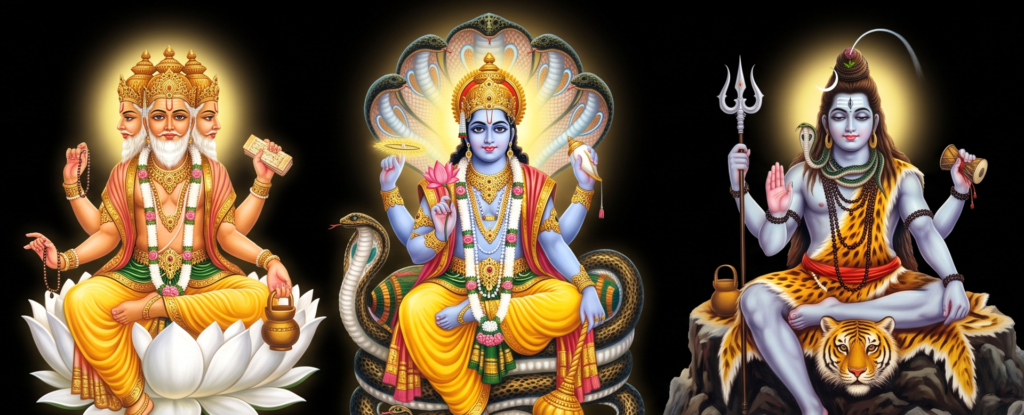
Topics Covered
Toggle